

What Is IPO Auction?
Before a U.S.-listed stock officially opens for trading on its first day, the exchange conducts a centralized auction to determine the opening price —
this is called the IPO auction. Unlike a standard opening auction, the IPO auction is specifically designed to establish a new stock's very first
opening price. The exchange publishes real-time auction updates to help market participants gauge the supply and demand dynamics of the new listing.
IPO auction data is displayed only during the auction phase on a stock's first day of listing, and is automatically hidden once the auction concludes.
Data updates in real time; the reference price and matched shares may change continuously. The final opening price is determined by the result at the
moment the auction ends.
Where to View?
Go to the individual stock quote page. An IPO auction data bar will appear above the price chart, displaying live auction progress.
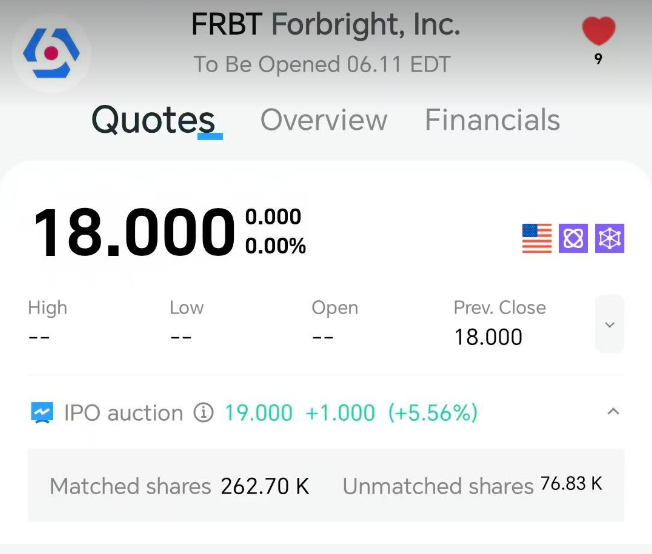
| Field | Description |
| IPO auction price | The indicative reference price during the current auction phase, representing the expected opening price. |
| Matched shares | The number of shares that can be matched between buyers and sellers in the current auction. A higher value indicates a greater degree of order matching at the current price level. |
| Unmatched shares | The number of remaining orders after matching, reflecting the supply-demand imbalance in the current auction book. |
How to Interpret the Data?
Using FRBT shown above as an example:
- IPO auction price 19.000 — higher than the IPO offer price of 18.000 (+5.56%), indicating strong buying interest and an expected opening price above the offer price.
- Matched shares 262.70K — a significant volume of buy and sell orders can be matched at the current price level.
- Unmatched shares 76.83K — a portion of buy orders have yet to find a matching seller, indicating that buyer demand slightly exceeds supply.
Permission Requirement
This feature requires users to hold LV2 US Stocks Level 2 Quote permission to access.
- Business / KOL Partnership
- cooperation@longbridge.hk
- Public Relations
- media@longbridge.hk
- Terms and Conditions
- Disclaimer
- Terms & Conditions
- Privacy Policy

A licensed corporation recognized by the SFC (CE No. BPX066). Holder of License Types 1 (Dealing in Securities), 2 (Dealing in Futures Contracts), 4 (Advising on Securities) and 9 (Asset Management). Also a registered HKEX participant and HKSCC participant.

Registered with the Monetary Authority of Singapore (MAS), Long Bridge Securities Pte. Ltd. is a Capital Markets Services Licence holder and Exempt Financial Adviser (Licence No. CMS101211).

A broker dealer registered with the Securities and Exchange Commission (SEC)(CRD: 314519/SEC: 8-70711), a member of the Financial Industry Regulatory Authority (FINRA) and Securities Investor Protection Corporation (SIPC).

A New Zealand registered Financial Service Provider (FSP number: FSP600050), and is a member of the Financial Dispute Resolution Scheme, a New Zealand independent dispute resolution service provider.